

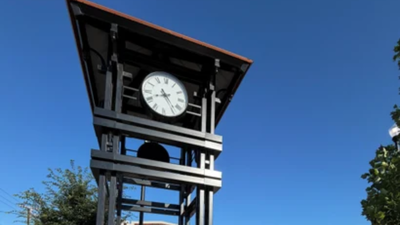
What began as a classroom design exercise by high-school students in New York has taken nearly a decade to become a reality. In 2017, students from North Tonawanda High School’s engineering academy were asked to imagine how a downtown park could be transformed. One of the winning ideas featured a clock tower and a landscaped gathering space.Nine years later, that concept has become part of a $1 million downtown improvement project in North Tonawanda, New York. The city recently marked the completion of Smart Growth 2.0, a redevelopment initiative that includes a new clock tower at Charles Fleischmann Park, upgraded walkways, landscaping, seating, lighting and other pedestrian improvements.The project was officially celebrated with a ribbon-cutting ceremony on September 2, 2026, bringing to life an idea that originated with local teenagers nearly a decade earlier.
A student idea takes shape
The clock tower is among the most visible changes at Charles Fleischmann Park. The concept traces back to 2017, when students were invited to think about what could make the small downtown park more attractive and useful to the community.The city eventually incorporated one of the students’ winning concepts into Smart Growth 2.0. According to project documents, the park improvements include new landscaping, reconfigured walkways, benches, dining tables, bike racks, lighting and irrigation, along with a decorative clock feature.The new project also extends beyond the park. Webster Street received pedestrian lighting and improvements to deteriorated paving, while landscaping and placemaking elements were added around the downtown area. Electric vehicle charging stations were also installed at the Manhattan Street parking lot.
Building on a decade-old investment
Smart Growth 2.0 is an extension of an earlier revitalisation programme that began in 2017. That year, North Tonawanda was selected for up to $2.5 million through New York’s Western New York Smart Growth Community Fund, part of Buffalo Billion II. The earlier funding supported projects including 400 linear feet of new docks and utilities at Gateway Harbour, a new harbormaster facility, an expansion of Charles Fleischmann Park and pedestrian improvements across downtown. The city said the $2.5 million investment helped leverage another $5 million for related projects.The latest $1 million initiative was designed to build on those improvements by making downtown spaces more attractive, walkable and welcoming.
Part of a $10-million downtown revival
Smart Growth 2.0 is one of 14 projects selected under North Tonawanda’s $10 million Downtown Revitalisation Initiative award. The broader programme aims to strengthen the city’s downtown and waterfront while encouraging new housing, business activity and public spaces.City officials say the improvements are intended to create a stronger identity for the downtown area. Mayor Austin Tylec described the project as a significant investment and an anchor for the city centre.Benjamin Bidell, a revitalisation specialist with the New York State Department of State, said the project was completed ahead of schedule and represents roughly the midway point of North Tonawanda’s broader Downtown Revitalisation Initiative programme.
From classroom sketches to a city landmark
The transformation of the park is particularly notable because the idea did not begin with architects, developers or city planners. It started with students being asked to imagine what their own downtown could look like. Nearly a decade later, one of those ideas has moved from a school exercise into the physical landscape of the city.For North Tonawanda, the project is part of a much larger effort to revive its downtown. For the students who participated in the original design challenge, however, the new clock tower offers something more personal: a visible reminder that ideas developed in a classroom can sometimes take years, public investment and persistence to become reality.The completed project also reflects the city’s broader shift toward pedestrian-friendly public spaces, combining landscaping, seating, lighting and other amenities designed to encourage people to spend more time downtown.As North Tonawanda continues implementing its Downtown Revitalisation Initiative projects, the student-inspired clock tower now stands as one of the clearest symbols of that transformation, connecting an idea imagined by teenagers in 2017 with a finished public space in 2026.