

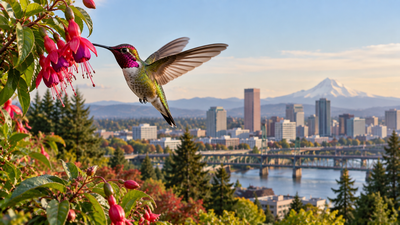
Anna’s hummingbirds have expanded their range across the Pacific Northwest, with a presence in cities such as Portland, Oregon. Once largely associated with California, the small, colourful birds gradually moved north and established populations in Oregon, Washington and British Columbia. Records show that numbers remained low for decades before rising rapidly from the late 1990s. Today, Portland has an estimated abundance of 2.01 Anna’s hummingbirds per party-hour, placing it alongside cities in northern California. Researchers link the expansion to population growth, introduced plants, ornamental gardens and hummingbird feeders, while climate change may have helped the species colonise some colder areas.
Portland’s Anna’s hummingbirds took decades to spread
According to the study published in The University of Chicago Press, titled ‘Ecological Release of the Anna’s Hummingbird during a Northern Range Expansion’, the history of Anna’s hummingbirds in the Pacific Northwest is therefore not simply a story of birds arriving and immediately becoming abundant. The research found that populations in Oregon, Washington and British Columbia were present by the early 1970s, but they remained at low densities for decades. In the north-west, populations were consistently recorded from the mid-1960s, followed by a much faster rise from the late 1990s.Portland provides a striking example of how far that change went. In the study’s abundance estimates, Portland recorded 2.01 birds per party-hour, compared with 1.74 in Seattle, 1.92 in Oakland and 1.89 in San Jose. In other words, the Portland figure had reached levels comparable with cities in the northern part of the hummingbird’s historic range. The research also notes that populations in the Pacific Northwest show stronger growth than those in the species’ native range.
Eucalyptus helped Anna’s hummingbirds expand
Earlier increases in Anna’s hummingbird numbers in California were associated with the spread of introduced flowering plants, particularly eucalyptus. The trees provided nectar during periods when food could otherwise become scarce. Historical accounts cited by the study suggested that this helped support larger wintering populations.The research describes how hummingbird feeders and ornamental garden plants helped support newly established populations in areas where the species had previously been uncommon. A separate study cited by Battey found that Anna’s hummingbirds in their expanded northern range were more likely to visit feeders and use human-modified landscapes. The relationship could also reinforce itself: people who noticed hummingbirds were more likely to put up feeders, potentially increasing the food available to the birds.
Climate change may have supported Northern Expansion
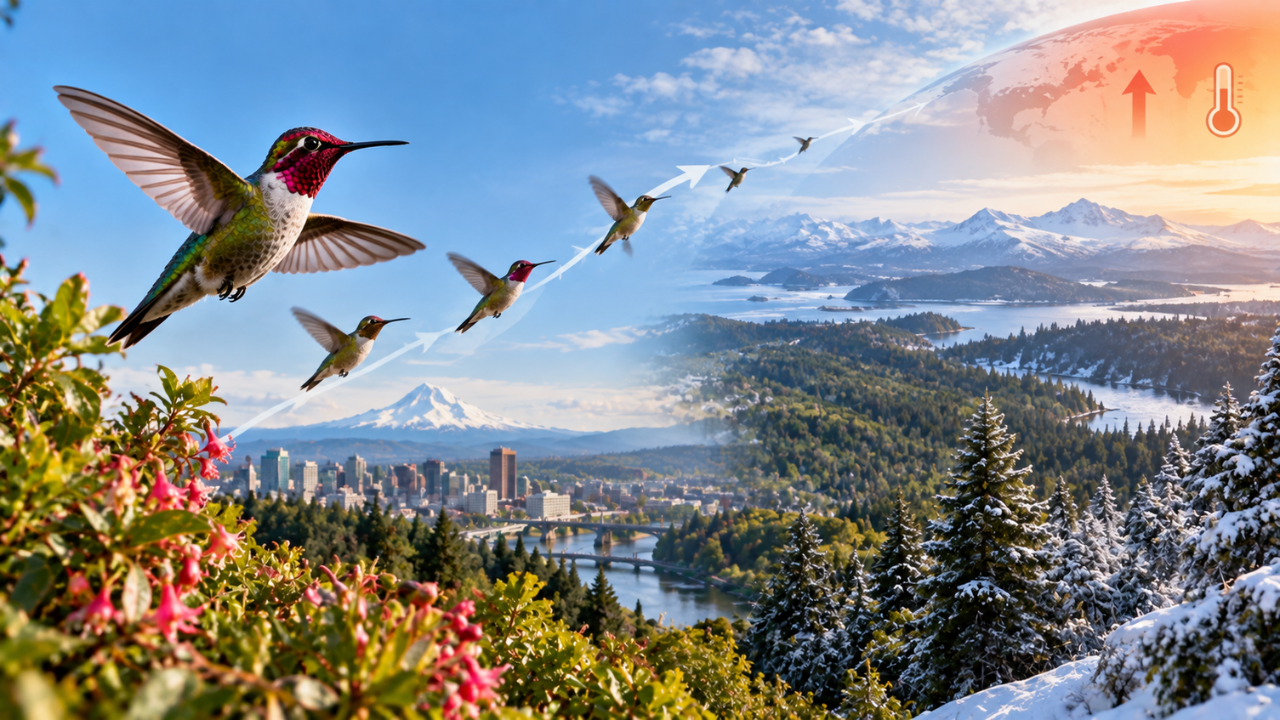
Image AI generated
Climate change may have helped the birds colonise some northern locations, but the study does not identify it as the main explanation for the earliest stages of the expansion. Climate models based on conditions from 1895–1925 failed to predict the newly occupied areas of the Pacific Northwest. However, the researchers found that the area with minimum breeding-season temperatures suitable for the species increased by about 11% between 1895–1925 and 1995–2015.The birds have also adjusted their breeding schedule as they moved north. Nest records showed that the median nesting date in the Pacific Northwest was 11 days later than in California, while the beginning of the nesting season shifted by roughly 17–32 days in the comparison. The study concludes that Anna’s hummingbirds have become common breeding birds across the lowland Pacific Northwest by combining range expansion, changes in nesting timing and increasing use of human-modified habitats.Portland’s estimated abundance had reached 2.01 birds per party-hour, showing how a bird that was once unusual in the region had become a familiar part of the city’s birdlife.