

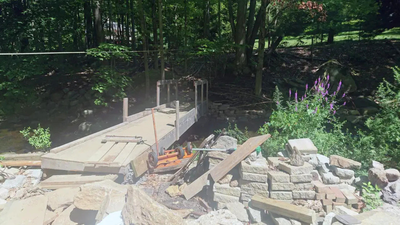
A 74-year-old homeowner in Bethel, Connecticut, has been ordered to address unpermitted work along a brook behind his property after a dispute with the town reached court. Mark Bjorken built a wooded bridge across Limekiln Brook and moved rocks along its banks, saying the work was intended to protect his property from erosion and restore the area. However, Bethel’s wetlands commission determined that the work required approval. Following a neighbour’s complaint in 2023, the town directed Bjorken to restore the brook or seek a permit. On September 10, 2026, Connecticut Superior Court Judge Barbara Brazzel-Massaro upheld the commission’s decision and dismissed Bjorken’s appeal, according to the News-Times.
How a bridge built to prevent erosion led to a court battle
The dispute began in 2023 after a neighbour reported that Bjorken had moved rocks and reinforced both sides of Limekiln Brook. According to the town, the work altered the flow of the brook and involved changes within a regulated wetlands area.A wetlands enforcement officer inspected the property and found moved rocks and a wooded bridge crossing the brook. Town officials subsequently directed Bjorken to restore the waterway or apply for the necessary approval from the wetlands commission.Bjorken maintained that his actions were intended to protect his property from erosion. He was concerned that the brook was moving closer to his home’s foundation, and he argued that the work was necessary maintenance and restoration rather than activity requiring a wetlands permit.
Homeowner argued that the work was necessary maintenance
In 2024, Bjorken submitted an application to the town. He argued that his activities qualified as residential landscaping, property maintenance and repairs, including the restoration and rehabilitation of his rear garden along the western bank of Limekiln Brook.The work reportedly involved removing debris from the brook and clearing diseased or dead trees that were lying in the water or likely to fall into it. Bjorken also repaired stones lining the bank, describing them as part of an existing wall that had fallen into disrepair.His argument was that these activities were intended to restore the property and address erosion, rather than introduce unauthorised changes to the waterway.
Why the wetlands commission rejected his application
Bethel’s wetlands commission rejected Bjorken’s request for an exception. The commission determined that the work went beyond routine maintenance and therefore required a permit.Bjorken had argued that the work fell within an exemption for residential landscaping and property maintenance. However, the commission said he had not provided enough information or documentation to establish that the work qualified for the exemption.The central issue was whether Bjorken’s activities could legally be treated as maintenance or whether the changes to the brook and its banks required formal approval under the town’s wetlands regulations.
Judge upheld the town’s decision
Connecticut Superior Court Judge Barbara Brazzel-Massaro issued a 10-page ruling on September 10, 2026. She upheld the wetlands commission’s decision and dismissed Bjorken’s appeal.The judge found that Bjorken had the responsibility to demonstrate that his work qualified for an exemption. The burden of proving the exemption applied rested with him, rather than with the commission.The ruling concluded that the commission had properly determined that work in the wetlands could not be authorised without a valid permit. The court therefore sustained the commission’s decision.
Homeowner described himself as a land artist
Bjorken, who owns a tree service business, has described himself as a “land artist”. He said the property was an “artist’s canvas” and explained that restoration work had been part of his professional life.He purchased the home approximately 10 years ago. In defending his actions, Bjorken said he was attempting to protect his investment from erosion and prevent the brook from getting dangerously close to his home.He also reportedly said that he could stand in his bedroom, open the window and fish, highlighting how close the waterway had come to the property. Bjorken maintained that he was trying to resolve the erosion issue and indicated that he intended to continue challenging the decision.
What the court ruling means for Bjorken
The ruling requires Bjorken to comply with the town’s requirements concerning the work along Limekiln Brook. He must either restore the brook to its condition before the work or apply to the wetlands commission for the appropriate permit.He also has the option of appealing the court’s decision. The ruling does not prevent him from seeking approval for work that may be permitted under the town’s regulations.