

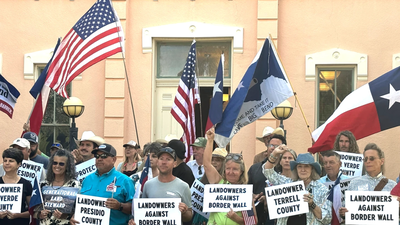
Texas landowners, ranchers and business owners are taking legal action to stop the Trump administration from building border walls and related infrastructure through the remote Big Bend region, arguing that the area does not face the high levels of illegal crossings used to justify the construction. The Associated Press and ABC News reported that the lawsuit was filed by Conserve Big Bend, a nonprofit focused on protecting the region’s landscape and heritage, along with six landowners, with dozens of others living along the border supporting the legal challenge. The case comes as the Trump administration pushes ahead with a $46 billion effort to secure the roughly 2,000-mile US-Mexico border. The plan includes 30-foot steel bollard walls, vehicle barriers and surveillance technology intended to prevent migrants and smugglers from crossing into the country.In Texas, the border project has faced resistance from landowners, environmental groups, local officials, sheriffs and tourism operators. Critics say the planned infrastructure could damage private property while also affecting the region’s distinctive environmental and cultural landscape.David Keller, an archaeologist and historian who specialises in the Big Bend and lives in the region, said at a press conference in Marfa announcing the lawsuit, as reported by the Associated Press, that residents were determined to protect the place they call home. “For us, the Big Bend is not an empty place on the map,” Keller said. “It is our home.”
Why landowners are challenging the border project
A central argument in the lawsuit is that the federal government is wrongly describing Big Bend as an area experiencing high levels of illegal border crossings. The Big Bend region stretches for roughly 500 miles along the US-Mexico border, representing about a quarter of the entire southern border. Yet historical Customs and Border Protection statistics cited in the lawsuit show that the region has accounted for only about 1% of border arrests.The plaintiffs argue that those figures undermine the administration’s justification for using special powers to accelerate construction. The Department of Homeland Security has relied on congressional authority that allows the secretary to waive certain environmental, archaeological and wildlife protections when officials determine that urgent border security needs require it.The legal challenge also comes as arrests along the border have fallen sharply since President Donald Trump returned to office. Laura Allen, whose family ranch could be divided by the proposed border wall, is a former county judge and a two-time Trump voter. Speaking at the press conference, she acknowledged the administration’s border-security efforts while urging officials to reconsider construction in the region.
Concerns over Big Bend National Park
Some of the strongest opposition has centred on Big Bend National Park, a remote national park in southwestern Texas where the Rio Grande forms the international boundary with Mexico. The park is known for its rugged terrain, limestone canyons, desert landscape and exceptionally dark skies, drawing visitors from across the world.The government has said in court proceedings that no final construction plan has been settled for the park. Proposals made public so far have included a new road, detection technology and barriers designed to prevent vehicles from crossing the border.In August, reports that bulldozers had begun clearing land inside the park triggered widespread criticism. Customs and Border Protection Commissioner Rodney Scott subsequently ordered a temporary pause on construction-related activity there. Opponents say a broader review is needed because the effects of border infrastructure could extend well beyond the immediate construction zone.Native American groups have warned that construction could interfere with religious practices and damage culturally significant sites. Environmental groups have raised concerns that walls and other barriers could alter natural drainage, contribute to flooding and disrupt wildlife migration. Landowners along the Rio Grande face another practical concern: access to the river. Many ranchers rely on the waterway to provide water for livestock and support agricultural activities. They say new barriers could make it difficult or impossible to reach the river from their property.For residents of Big Bend, the lawsuit is therefore about more than stopping a wall. They argue that border-security infrastructure should take into account the region’s low historical crossing numbers, fragile environment, cultural heritage and the people whose land and livelihoods could be directly affected.